

Quick answer: To protect your hair from heat styling, use a flat iron or curler on fully dry hair only, apply a heat protectant to the lengths and ends, choose the lowest temperature that does the job, make one slow pass instead of several fast ones, and let each section cool before you brush it. On ordinary days, drying on a low or cool setting is often enough instead of full straightening.
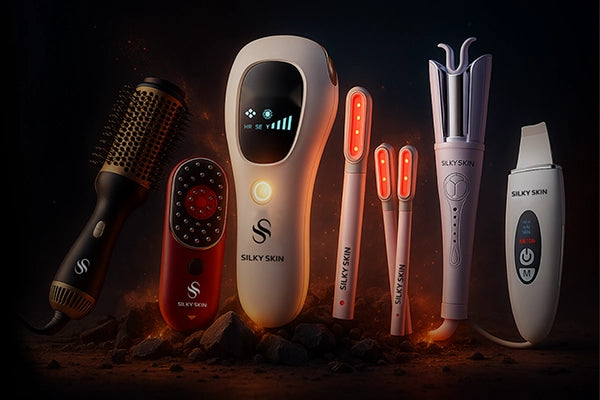
Many women in the UAE use more than one heat tool a week: a 5-in-1 hot air brush for everyday drying, a ceramic plate hair straightener for occasions and an automatic hair curler for waves. This guide does not repeat how to use each tool in detail; it brings together the care habits that reduce excess heat on your hair whatever the tool.
Why does hair need protection when heat styling?
Heat is what lets hair take a straight or curled shape, but too much or too frequent heat can leave the ends drier and frizzier over time, especially on fine, coloured or chemically straightened or keratin-treated hair. The aim is not to give up styling tools but to use them wisely: less heat, fewer sessions and the right steps before and after styling.
Five rules for protecting hair from heat
- Fully dry hair before a flat iron: do not use a straightener or curler on wet or damp hair. Dry it first with a hot air brush or a hair dryer.
- Heat protectant every time: apply it to the lengths and ends before styling and comb it through evenly. The Silky Skin styling product pages themselves recommend a heat protectant.
- The lowest heat that works: start at the lowest setting and raise it step by step only if the section does not respond. Do not start at the top temperature.
- One slow pass: fast, repeated passes over the same section expose it to heat more times. Small sections with one slow pass give a clearer result at lower heat.
- Let each section cool: hair sets into its new shape as it cools, so do not brush or touch it straight after styling.
Heat protection by tool
Hair straightener
The Silky Skin straightener has 3.8 cm keratin-ceramic plates and multiple temperature settings, and heats up in about 60 seconds according to the product specifications. The product images include a temperature chart by hair type: 120–140 °C for fine or stressed hair, 150–170 °C for normal hair, 180–200 °C for thick hair and 210–230 °C for very thick, curly hair only when needed. For the full details, read the hair straightener temperature guide by hair type.
- If your hair is coloured, chemically straightened or keratin-treated, start at the lowest range whatever its thickness.
- Test on a small section from the under layer before the rest of your hair.
- Do not hold the plates still on a section; glide them at an even speed from roots to ends.
5-in-1 hot air brush
The Silky Skin 5-in-1 hot air brush is rated at 1000 W, with two air speeds and three settings: AIR for cool air, LOW for low heat and HIGH for high heat. It combines drying and styling in one step, so you can skip a dryer followed by a flat iron.
- Start on towel-dried hair, not dripping-wet hair.
- Use LOW on most days and keep HIGH for thick hair or stubborn sections.
- Finish each section on the cool AIR setting to set the shape and reduce frizz.
To see when the brush is enough and when you need a dryer, read hot air brush vs hair dryer and the hot air brush guide.
Automatic hair curler
The Silky Skin automatic hair curler winds each section automatically around a 26 mm ceramic-coated barrel, with multiple operating settings and an automatic shut-off according to the product page.
- Use it on dry, combed hair, in small sections.
- Do not keep a section in the barrel longer than the look you want needs.
- Keep it away from the scalp and face, and let each curl cool before separating it with your fingers.
For the full steps, read how to use an automatic hair curler step by step.
A weekly routine with less heat
| Day | What to do |
|---|---|
| Ordinary days | Dry with the hot air brush on LOW and finish with cool AIR, or let your hair air-dry partly. |
| Occasion day | Straighten or curl with a heat protectant and the lowest suitable temperature. |
| The next day | Do not straighten everything again; refresh only the fringe or front sections if needed. |
| Rest day | No heat: a soft braid or low bun, and a light oil or serum on the ends. |
Tips for UAE humidity
- Do not raise the heat to fight humidity; focus on cooling each section and setting it with a light anti-humidity product.
- Style in a cool, dry, air-conditioned room and let your hair cool before going out into humid air.
- On very humid days, soft waves or a neat bun can be a practical look that needs less heat than full straightening.
Common mistakes that add heat to your hair
- Using a flat iron on hair that is not fully dry.
- Starting at the highest temperature every time.
- Passing the iron over the same section many times.
- Full straightening every day with no rest days.
- Brushing or touching sections before they cool.
Caring for the tools themselves
A clean tool glides through hair more easily. Let the device cool completely after use, then wipe the plates or barrel with a soft, dry cloth to remove product residue. Do not use the device near water, and keep it out of children's reach. Browse all Silky Skin hair care devices with delivery across the UAE and the GCC.
Frequently asked questions
Is a heat protectant enough on its own?
A heat protectant is an important step, but it does not replace the rest: fully dry hair before using a flat iron, the lowest temperature that does the job, one slow pass instead of repeated passes, and heat-free days during the week.
What temperature should I use on a hair straightener?
It depends on your hair type. The temperature chart in the Silky Skin straightener images suggests 120–140 °C for fine or stressed hair, 150–170 °C for normal hair, 180–200 °C for thick hair and 210–230 °C for very thick, curly hair only when needed. Start at the lowest range and raise the heat step by step.
Can I use a straightener on wet hair?
No. Use a flat iron or an automatic curler on fully dry hair only. Dry wet or damp hair first with a hot air brush or a hair dryer.
How often can I heat style my hair each week?
There is no single number for everyone. The practical rule is to heat style as rarely as you can, use the cool or low setting on ordinary days, and give your hair rest days between straightening or curling sessions.
Which is gentler on hair: a hot air brush or a straightener?
A hot air brush works with warm air and combines drying and styling in one step; the Silky Skin 5-in-1 brush has a cool AIR setting plus LOW and HIGH heat. A flat iron touches the hair with heated plates and gives a sleeker finish. Choose the tool for the look you want and start with the lowest suitable setting either way.
Why does my hair frizz back so quickly in UAE humidity?
High humidity makes hair absorb water from the air and return to its natural shape. Instead of raising the heat or passing the tool again, let each section cool after styling, finish with cool air and set the style with a light anti-humidity product.